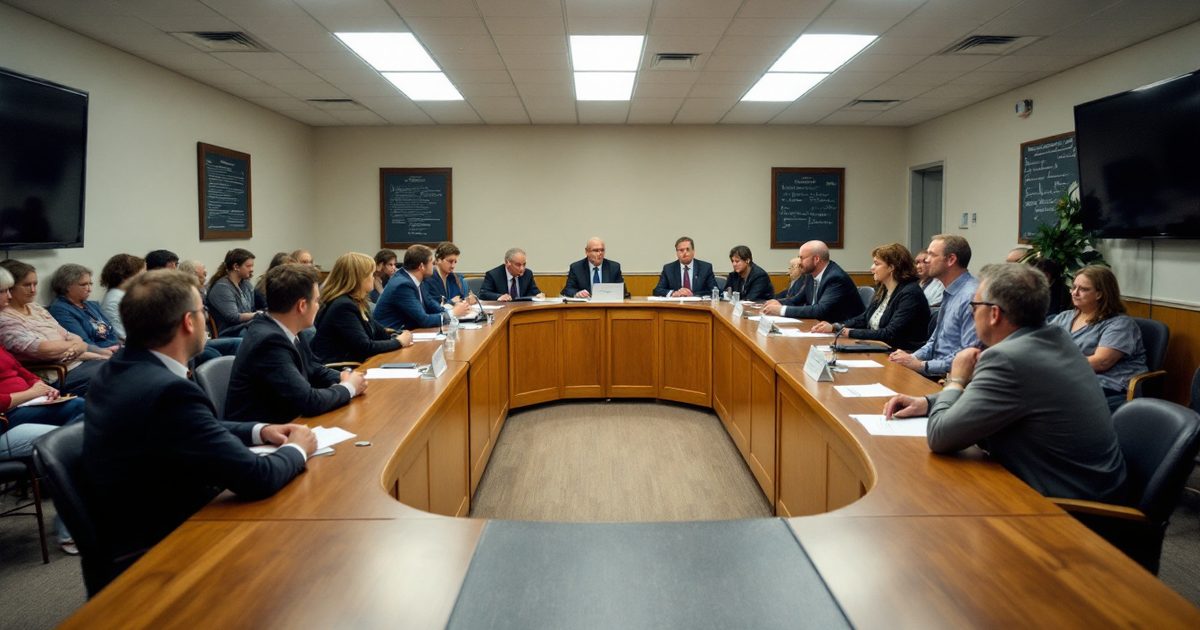
The New Hampshire Senate on Thursday passed a sweeping homeschool deregulation bill that would lift virtually every form of state oversight currently imposed on families that home-educate their children, sending the measure back to the House for further negotiation over an unrelated pharmacy benefits manager amendment that Senate Republicans tacked onto the legislation. According to reporting from New Hampshire Public Radio, the bill cleared the chamber with unanimous Republican support and across-the-board Democratic opposition.
If signed into law in its current form, the legislation would erase three pillars of the state’s existing home-education framework: the requirement that parents notify a school district or the state that they are home-educating a child, the duty to maintain a record of the educational materials being used, and the obligation to subject a homeschooled child to an annual academic evaluation. The change would amount to one of the largest reductions in state oversight of home education in decades and would put New Hampshire among the most permissive states in the country on that front.
Where the Bill Came From and What It Does
The bill, which the General Court has been tracking under the catch-all designation tied to its bill status entry, is supported by Cornerstone Action and Americans for Prosperity – two of the most active conservative advocacy organizations in Concord – and is opposed by teachers unions, school administrators, and Senate Democrats. The core argument from supporters is that the existing framework treats homeschool parents as suspects in need of monitoring, when in their view the parental right to direct a child’s education is foundational and should be presumed.
Sen. Daryl Abbas, a Salem Republican who served as the bill’s floor presenter, framed the changes in those terms before the Senate vote. “The bill as amended modernizes the state’s home education framework by revising its definitions and administrative requirements by better recognizing a parent’s right to direct their children’s education,” Abbas said.
The legislation also clarifies that families who home-school using the state’s Educational Freedom Account program – New Hampshire’s voucher-style scheme that funnels per-pupil education funding to families – can continue to access selected resources at their local public schools. Specifically, the bill spells out that EFA recipients who home-school can rely on public schools for special education services, individual courses, and athletics participation. Republicans argue that flexibility lets families build a customized education without losing access to taxpayer-funded supports they help fund.
The Democratic Pushback: “Extreme Overreach” and “Double-Dipping”
Senate Democrats walked away unconvinced. Sen. Debra Altschiller, the Stratham Democrat and a former home-school parent herself, leveled the most pointed critique on the floor. “They can take spots on sports teams, take spots in a crowded AP class, be in science classes with additional labs, while they are also taking a voucher,” she said. “This bill is extreme overreach; it is the definition of double-dipping.”
Altschiller’s argument crystallizes a long-running fault line in the New Hampshire school choice fight: when public dollars follow a homeschool student through the EFA, but that student also occupies finite public-school resources – a slot in a calculus class, a roster spot on the basketball team, a seat in a science lab with limited equipment – traditional public-school families argue they are losing access while paying twice. Republicans counter that those families are taxpayers too and that public schools should not be cordoned off from their own residents.
The deeper concern Democrats and education professionals voice is harder to dismiss as ideological: with no notification requirement, the state would have no idea how many children are being home-educated. With no recordkeeping requirement and no annual evaluation, there would be no academic check whatsoever – not even a portfolio review or a standardized test – to confirm that any actual education is taking place. Critics argue this creates a blind spot that could mask everything from poor academic outcomes to, in extreme cases, child neglect or abuse where attendance at a public school is one of the only routine touchpoints children have with mandated reporters.
A Pharmacy Benefits Manager Detour
In a procedural twist that complicates the bill’s path forward, the Senate also attached language from a separate Senate bill on pharmacy benefits managers – one that had failed to gain traction in the House this session – to the homeschool legislation. The PBM provisions are unrelated to home education and were added to keep the underlying policy alive in some form, but the move means the bill will now have to go back to the House for sign-off on a substantially expanded vehicle.
NHPR reported that the core homeschool policies are “staunchly backed by Republican leaders in both the House and Senate,” meaning the educational provisions are unlikely to be a stumbling block. The PBM piece is the wildcard. If the House refuses to swallow the pharmacy language, the bill could end up in a committee of conference, where negotiators from both chambers would have to reconcile their versions before sending anything to Gov. Kelly Ayotte’s desk.
A Larger Pattern in Concord
The homeschool bill arrives in the context of an aggressive Republican agenda this session that has already moved on multiple education and parental rights fronts. The same Senate that approved this measure has been a venue for broader fights over local control, school choice, and the role of the state government in family decisions. Some recent moves have stalled, like a number of anti-vax measures that fizzled out in the State House. Others have advanced, including a data center zoning preemption push that drew local-control objections and executive council fights over DEI conditions on childcare grants.
For New Hampshire’s roughly several thousand home-education families, the bill represents the natural next step in a long-running effort to dismantle what supporters see as bureaucratic intrusion. For its critics, the loss of even minimal annual evaluations and notification rules takes the state from a relatively light-touch regime to one with effectively no public oversight – at the same time the EFA program is steering more public dollars to homeschool households than ever before.
The bill’s House journey will determine how much, if any, of that framework survives. Either way, the Senate’s vote Thursday signals the policy direction in Concord: less state, more parent.


