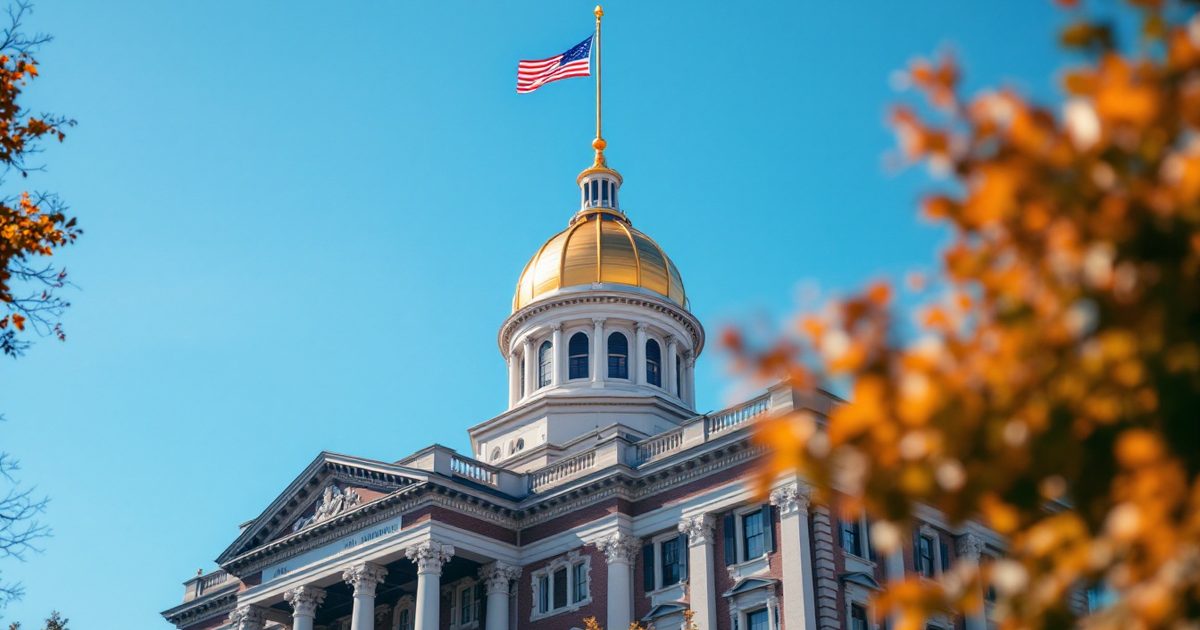
A bill that would have allowed firearms on New Hampshire’s public college campuses has been redirected to a study committee after the Senate Judiciary Committee voted along party lines to amend the measure. The move effectively stalls legislation that the House passed earlier this year by a 188-165 margin, and it signals that even in a gun-friendly state like New Hampshire, the prospect of armed students on university grounds remains politically fraught.
From House Floor to Senate Holding Pattern
The original bill cleared the New Hampshire House with a comfortable but not overwhelming majority earlier in 2026. Supporters framed it as a natural extension of the state’s strong tradition of firearms rights, arguing that law-abiding adults should not lose their Second Amendment protections simply because they step onto a college campus.
But the bill’s journey stalled when it reached the Senate Judiciary Committee. Senate President Sharon Carson introduced an amendment that would replace the bill’s operative provisions with a directive to study the feasibility of permitting firearms on public higher education campuses. The committee approved Carson’s amendment on a party-line vote, transforming the legislation from an actionable policy change into an open-ended research project.
The amended bill would also examine the possibility of prohibiting restrictions on non-lethal weapons such as pepper spray and personal defense devices on campuses — a provision that could find broader bipartisan support if it eventually moves forward as standalone legislation.
Opposition from Campus Leaders and Law Enforcement
The University of New Hampshire’s leadership has been vocal in its opposition to campus carry, joining a chorus of higher education administrators across the country who argue that firearms on campus create safety risks that outweigh any deterrent effect. Campus law enforcement officials have echoed those concerns, noting that active shooter response protocols become significantly more complicated when officers cannot quickly distinguish between a threat and a legally armed bystander.
The opposition from institutional stakeholders appears to have given Senate Republicans pause. Rather than forcing a floor vote that could have split their caucus or produced a politically awkward outcome, the study committee route allows the majority party to demonstrate engagement with the issue without committing to a specific policy direction.
Democrats See a Political Maneuver
Not everyone views the study committee as a good-faith effort. Sen. Debra Altschiller (D-Stratham) offered a pointed assessment of the amendment’s true purpose during committee deliberations.
“Nobody asked for us to do a study committee because they thought that looking into the possibility of putting firearms on college campuses outside of the scope of law enforcement was an idea worth looking into,” Altschiller told NHPR.
Her implication was clear: the study committee is a mechanism to avoid a direct vote on a divisive issue, not a genuine effort to gather information that might inform future policy. Democrats have pointed out that extensive research already exists on campus carry policies in the more than twenty states that allow some form of concealed carry on college grounds.
Governor’s Silence Speaks Volumes
Governor Kelly Ayotte has notably declined to weigh in on the campus carry debate, neither endorsing the original House bill nor praising the Senate’s decision to study the matter further. That silence is itself significant. In a state where gun rights enjoy broad political support, the governor’s reluctance to champion a pro-carry position suggests that internal polling or stakeholder feedback may have revealed more public ambivalence than the House vote indicated.
The study committee is expected to convene during the interim period between legislative sessions. Its findings and any resulting recommendations would not be actionable until the next session, pushing any potential campus carry policy into 2027 at the earliest.
For students, parents, faculty, and campus safety professionals across the University System of New Hampshire, the delay provides breathing room — but not resolution. The underlying policy question remains unanswered, and the political dynamics that produced this particular stalemate are unlikely to shift dramatically before the issue resurfaces.
The New Hampshire Review will continue tracking the study committee’s progress and any developments from the governor’s office on this issue.
What happened to the New Hampshire campus carry bill?
The House passed the campus carry bill 188-165 earlier in 2026, but the Senate Judiciary Committee voted along party lines to amend it into a study committee directive. Senate President Sharon Carson introduced the amendment, which means the bill will not receive a direct vote this session and firearms policy on public college campuses will be studied during the interim period.
Who opposes campus carry in New Hampshire?
The University of New Hampshire leadership and campus law enforcement have been the most prominent opponents, arguing that allowing firearms on campus creates safety risks and complicates active shooter response. Several Democratic senators have also opposed the bill, with Sen. Debra Altschiller characterizing the study committee as a political maneuver rather than a genuine research effort.
When could campus carry become law in New Hampshire?
With the bill diverted to a study committee, any campus carry legislation would not be actionable until at least the 2027 legislative session. The study committee will convene during the interim period, and its recommendations would need to be introduced as new legislation in the next session. Governor Ayotte has not publicly stated a position on the issue.


